


Waterjet Cutting: How Cold Processing Solves Challenges with Heat-Sensitive Materials
2026-08-19
Waterjet cutting has established an irreplaceable position in the processing of heat-sensitive materials thanks to its "cold processing" characteristics. It operates by utilizing the kinetic energy of an ultra-high-pressure water stream—often mixed with abrasives—to erode and remove material; the temperature rise in the workpiece is minimal (measured at only 50–70°C), thereby fundamentally avoiding thermal damage.
Experimental data highlights the practical value of this cold processing method. In tests cutting the heat-sensitive material SIPAS 60, researchers observed no dimensional inaccuracies, ablation, or melt droplets. Crucially, increasing the abrasive mass flow rate by 75% improved the roughness of the bottom cut surface by 50%, while raising the water pressure from 250 MPa to 350 MPa also significantly enhanced the quality of the lower cut section. These parameter adjustments directly improved cut quality rather than merely compensating for thermal deformation.
A comparison with laser cutting best illustrates the distinction. Laser cutting is a thermal process that leaves a heat-affected zone (HAZ) when processing heat-sensitive materials, potentially causing edge hardening, oxidation, or alterations to the material's microstructure. In contrast, waterjet cutting generates no HAZ, ensuring the material's chemical properties remain identical to those of the base material. Regarding speed, waterjets can cut heat-sensitive materials more than ten times faster than thermal processing tools such as solid-state lasers, EDM, and plasma cutters. However, there are trade-offs: waterjet cuts exhibit a slight taper, cutting speed drops significantly as material thickness increases, and abrasive consumption represents an ongoing cost.
Waterjet cutting is not intended to replace laser cutting. For high-speed processing of thin sheets, lasers remain the efficiency leaders. Yet, when materials are heat-sensitive or require strict edge performance, the waterjet—relying on the simple logic of "no heat"—offers a solution that thermal processing methods cannot match.
Experimental data highlights the practical value of this cold processing method. In tests cutting the heat-sensitive material SIPAS 60, researchers observed no dimensional inaccuracies, ablation, or melt droplets. Crucially, increasing the abrasive mass flow rate by 75% improved the roughness of the bottom cut surface by 50%, while raising the water pressure from 250 MPa to 350 MPa also significantly enhanced the quality of the lower cut section. These parameter adjustments directly improved cut quality rather than merely compensating for thermal deformation.
A comparison with laser cutting best illustrates the distinction. Laser cutting is a thermal process that leaves a heat-affected zone (HAZ) when processing heat-sensitive materials, potentially causing edge hardening, oxidation, or alterations to the material's microstructure. In contrast, waterjet cutting generates no HAZ, ensuring the material's chemical properties remain identical to those of the base material. Regarding speed, waterjets can cut heat-sensitive materials more than ten times faster than thermal processing tools such as solid-state lasers, EDM, and plasma cutters. However, there are trade-offs: waterjet cuts exhibit a slight taper, cutting speed drops significantly as material thickness increases, and abrasive consumption represents an ongoing cost.
Waterjet cutting is not intended to replace laser cutting. For high-speed processing of thin sheets, lasers remain the efficiency leaders. Yet, when materials are heat-sensitive or require strict edge performance, the waterjet—relying on the simple logic of "no heat"—offers a solution that thermal processing methods cannot match.
CUTTING METHOD

-
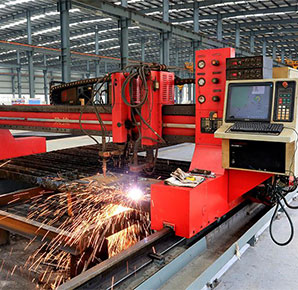 Flame cutting, also called oxyfuel cutting, is a common machining method for heavy plate.
Flame Cutting
-
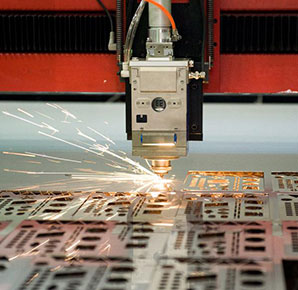 Plasma cutting is a process that cuts through electrically conductive materials by means of an accelerated jet of hot plasma.
Plasma Cutting
-
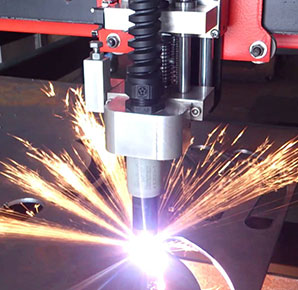 Basically when cutting with the laser, the beam is focused on the material through the hole in the nozzle.
Laser Cutting
-
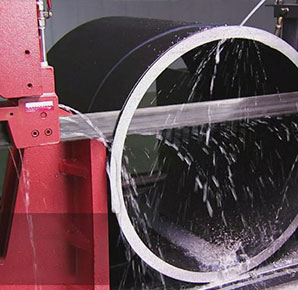 According to the form of the tool, sawing/ saw cutting is divided into bow sawing, circular sawing, band sawing and sawing of the grinding wheel.
Saw Cutting
Latest Products
-
 Machining involved: plasma cutting, grinding, polishing Application: construction
Stainless Steel Cutting Parts
-
 Machining involved: flame cutting, beveling Application: engineering and ships building
Mild Steel Heavy Plates Cutting
-
 Material: stainless steel. Laser cutting: high precision, fastest cutting method, suitable for cutting iron steel within 20mm....
Automobile Steel Parts
-
 Customized Steel Tube for Construction Equipped with laser cutting, CNC shearing, punching, bending, automatic riveting, auto...
Customized Steel Tube for Construction
-
 Machining involved: saw cutting, grinding, surface treatment
Saw Cutting for Alloy Steel Bars
-
 Machining involved: cutting, grinding
Metal Steel Cutting for Construction Machinery
-
 Customized Heavy Plates Cutting Parts are for Engineering Machinery. Material: carbon steel Machining involved: flame cutting...
Customized Heavy Plates Cutting Parts
-
 Special Shaped Steel Cutting is for Construction.
Special Shaped Steel Cutting for Construction
CONTACT US
No limited to time and space, you can call for our online-service personnel for consultation, or fill in the table below for an enquiry. Your message will be promptly resolved.
- Tel:+86-21-61182423
- Fax:+86-21-61182425
- E-mail:[email protected]
- Skype:shanghai.katalor
- Address:Unit 6,lane 2500,xiupu Road,Kangqiao Industrial Area,Pudong New District,Shanghai
- Online Consultation
- After-sales Engineer